
LOG KYA KAHENGE- “HER REAL SHACKLES”
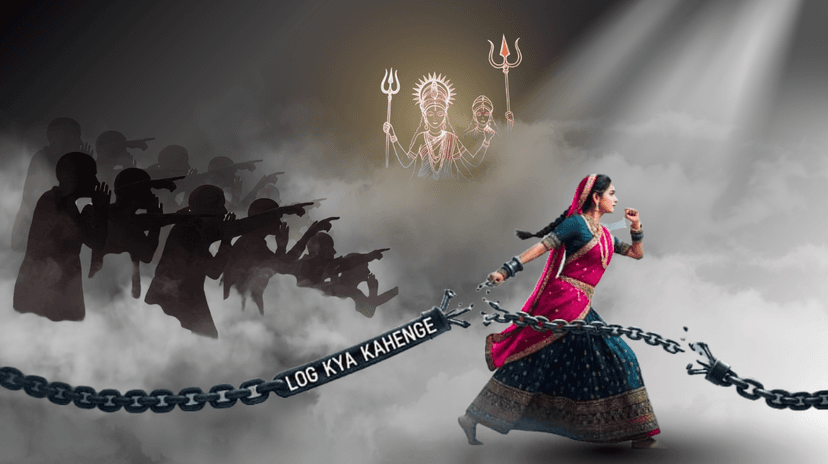
Ananya, a 21 year old, had finally secured admission to an art school in Paris — a dream she had nurtured since childhood. Her brushes had always brought her a taste of freedom. But her mother’s words froze her heartbeat: “Beta, log kya kahenge? People will talk if you go so far from home. And what about your marriage? What about family responsibilities?” Suddenly, her dreams felt heavy by the whispers of the society she could not escape. She didn’t argue, She didn’t fight, She quietly deferred her admission.
Society perfected the art of asking the wrong questions: Who will you marry? Will your family be embarrassed? Is this respectable? Meanwhile her aspirations, emotions, and even her identity are politely pushed aside — as if ambition and honor can’t coexist for women.
Why is ambition “dangerous” for women but “exciting” for men? Why must boys hide their tears while girls hide their dreams? Why do a boy and a girl have to hide their love and feelings? — all for what the society thinks? Education, career, marriage, clothes, even when a couple is supposed to have a child. Apparently, nothing is truly your choice, it’s just an image of what the society wants from you.
“Log Kya Kahenge” has been haunting us for generations. Families, relatives, neighbors, every unrelated person somehow becomes a judge of our lives. “Society”, a nameless and faceless crowd, decides what’s acceptable. And somehow, we listen. We hide our dreams and desires — just to keep those four people in the society happy.
Why do we care so much about people who don’t even know any of our struggles and pain? Why do their opinions weigh heavier in our minds than our own hearts? Over time, these invisible rules became law, and we carry them with us every day, forgetting what it even feels like to live freely.
"Living under ‘Log Kya Kahenge’ isn’t just about rules — it’s like an invisible hand weighing you down, judging every choice you make.You laugh a little softer, dream a little smaller, even change how you walk or speak, because somewhere in your brain, that question lingers. You don’t realize it but you wear a facade daily just to fit in and not to be questioned.
Even someone like Kalpana Chawla, who dreamt of touching the stars, might have faced that question: “Are you sure a girl should leave home for this? What will society say?” But at last she still did it as the “First woman in space.”
Mary Kom, stepping into the boxing ring for gold, didn’t just fight her opponents — she fought the whispers asking if a woman should chase dreams while still “being family.” She had to face a lot of criticism from the society, questioning her existence in a male dominated field.
This “log kya kahenge” ideology didn’t just pop up one day out of nowhere-it’s something we inherited from generations before us.. Our grandparents lived in a world where everyone knew each other, and your worth was basically your reputation. One slip, one whisper, and you were done.Back then, staying silent and obeying wasn’t just expected — it was how you survived. Women carried the family’s so-called honor on their backs. We’ve been carrying their fear ever since,passing the trauma down and pretending it’s culture. It’s not. It’s just old fear wearing a fancy name.
For women, the pressure is heavier: you want freedom, but you’re reminded to adjust, to behave, to put family honor before yourself. Why is it only a woman’s responsibility to uphold a family’s honor? And if that honor is ever touched, women are the ones who pay the price.
Even when a woman is sexually abused, she’s asked to stay silent — not for her peace, but so that the neighbors don’t talk. It’s a cruel truth: in our society, how a woman’s dignity can be joked upon. Usne kapde aise pehne the, toh aisa toh hoga hi . But a family’s reputation must stay spotless.
The Nirbhaya case shook the nation, but there are countless other Nirbhayas we never hear of — a woman is forced to swallow her pain because speaking out would bring shame. Even if they actually speak out, only a woman's character and upbringing will always be questioned.
Men aren’t free either, tears are seen as weakness and vulnerability is looked down upon. A real man never cries; that’s the rule set for men expected to be ‘strong’ at all times.In all this, mental health often gets dismissed. “You’re just overthinking”, “It’s just stress,” people say,as if that can cure the weight sitting on your chest. Therapy? It’s still treated like a scandal. You can’t just walk into a psychologist’s office without becoming the center of gossip. One visit, and suddenly you’re put into neat little boxes, labelled — “Pagal hai… kuch toh problem hai”. In a moment, you stop being a person who needs help, and you turn into a story for people to talk about.
Society is filled with “Hypocrites". The same people who tell men 'real men don’t cry' are the first to break down when life hits them hard. The ones who say “don’t talk about your problems” are the first to run to their friends when life gets hard. It’s not about strength,it’s about pretending.
And then there are people “rebels” , the ones who just don’t care anymore. Like the guy who ditched his “safe” desk job to sell momos on the street because that made him happier than any paycheck. Everyone laughed, until they saw the crowd outside his stall. Or the woman who refused to marry just because her relatives thought it was the right time according to them. She chose to make her own decisions and she’s never had to ask anyone’s permission to be happy.
In the end, “log kya kahenge” is just background noise — the same tired voices that will find something to say no matter what you do. It’s high time for the youth of today’s generation to break the chains of generational trauma. Don’t let society make decisions on your behalf. At the end of the day, you’re the one who will face the consequences, not them. So be selfish when it matters. Choose yourself, even if it pisses people off. Because the truth is that society will judge you even if you try to breathe.
“Society can watch all it wants; you’re the one writing your story.”
Published on:
3 November 2025